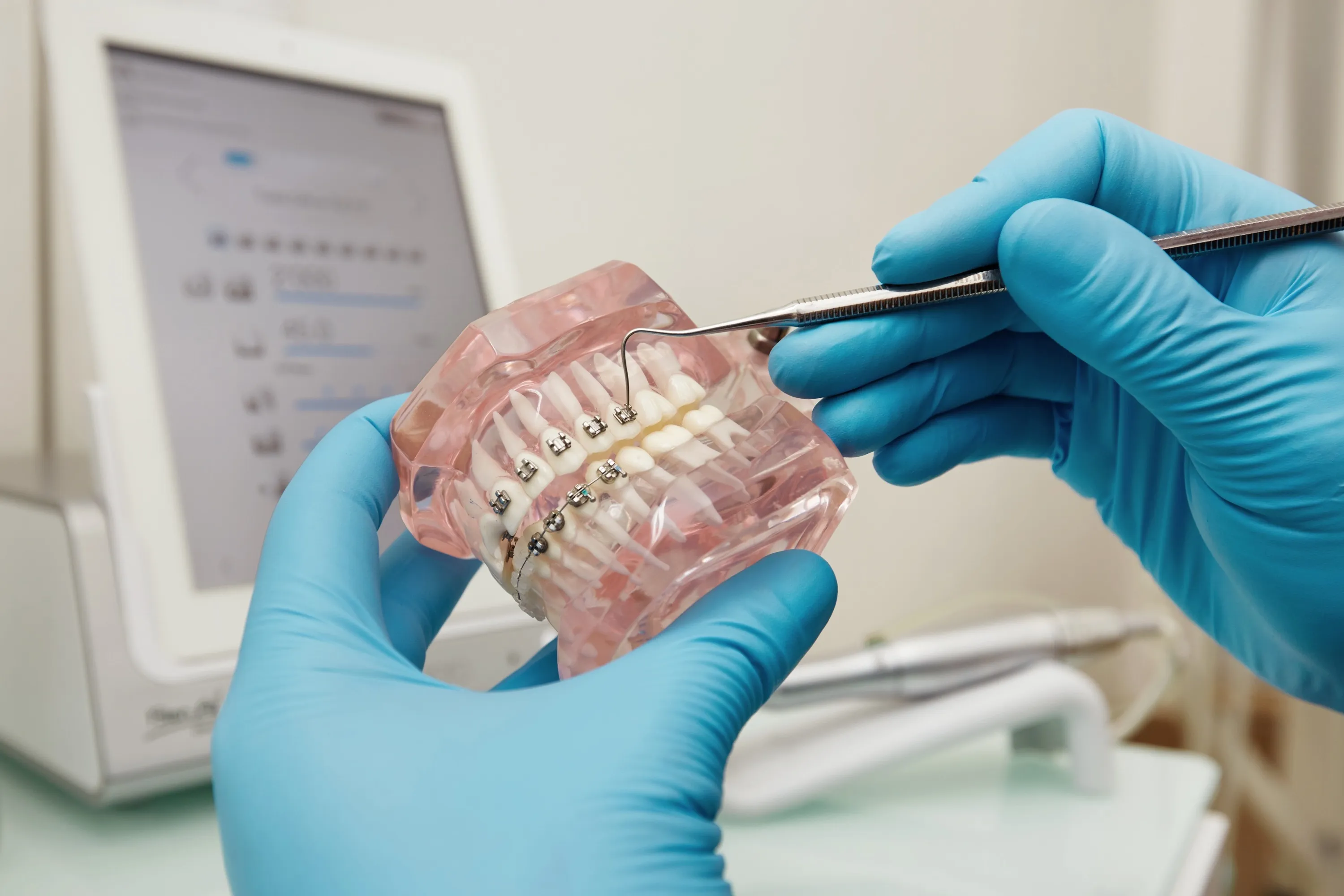

When it comes to aligning the dental arch, patients often wonder what is better – aligners or braces? However, the choice between them is not limited to which system is less noticeable. Clear aligners are removed during eating and brushing, but they need to be worn for 20–22 hours a day. On the other hand, a fixed system does not depend on the patient's discipline and allows the orthodontist to more closely monitor the movement of teeth, but it requires more meticulous hygiene and dietary restrictions. The duration and overall cost of these two methods primarily depend on the bite, complexity, and treatment plan. Therefore, the optimal method – braces or aligners – is chosen based on the results of the diagnostics.
Prices for related services
- Orthodontic Treatment with Braces System (two jaws, without the cost of the system)84510 uah
- Adult orthodontic diagnostics, expert level20690 uah
- Children's orthodontic diagnostics (up to 12 years old)4760 uah
- Treatment with the Invisalign Comprehensive aligner system311580 uah
- Adult orthodontic diagnostics7570 uah
- Orthodontic treatment with a braces system (both jaws, excluding the cost of the system), expert level124860 uah
- Treatment with Invisalign Moderate DA aligner system283250 uah
Briefly about the difference between braces and aligners
Braces — are a non-removable system consisting of brackets glued to the teeth, an orthodontic arch, and additional elements. The arch creates a controlled force, and the dentist adjusts the system during scheduled visits. It cannot be removed independently, so the movement is ongoing. There are metal and ceramic options that differ in appearance, properties, and price.
Aligners are a series of individual transparent trays. Each one gradually moves the teeth according to a digital plan, after which the patient proceeds to the next one. During installation, the doctor may attach small composite attachments to the teeth, and sometimes elastics or other auxiliary elements. Therefore, the question of which is better, aligners or braces, does not have a universal answer, as the capabilities of the systems depend on the anomaly, planning, and the experience of the orthodontist.
Comfort and aesthetics: what is more noticeable and convenient in everyday life
Transparent aligners are less noticeable, although attachments, elastics, and the edge of the trays can sometimes be seen up close. They are removed before meals, so there are no restrictions on hard or sticky foods. Teeth can be cared for with a regular toothbrush and floss, but the mouth must be thoroughly cleaned after eating before putting the trays back on. Additionally, hot drinks can deform the material, and sweets under the tray increase the risk of cavity formation.
The fixed brace system is more noticeable and may irritate the mucous membrane in the first few days. After installation, there may be temporary sensitivity in the teeth. Furthermore, caring for braces involves using interdental brushes, single-tufted brushes, or an irrigator. Doctors also recommend limiting hard and sticky foods to prevent damage to the system.
In everyday life, the differences between these two systems are assessed as follows:
- Aligners can easily be forgotten to wear, which will affect the results;
- Braces are always worn, but they require more careful hygiene and caution with food;
- Trays may temporarily affect speech, while brackets may irritate cheeks and lips;
- Both systems require regular check-up visits to the dentist.
Treatment duration: what affects the length
The duration of treatment depends not on the type of system, but on the extent of the problem: crowding of teeth, type of malocclusion, need for extraction, condition of the bone tissue, and planned movements. Age, tissue response, frequency of visits, possible damage to the system, and adherence to recommendations also affect the timelines.
It cannot be definitively stated that aligners straighten teeth faster than braces. For simple malocclusion cases, the treatment duration with both methods may be approximately the same. However, in more complex situations, braces are often used since they allow for more precise control of tooth movements, changing their position in different planes, and correcting pronounced malocclusions.
The effectiveness of treatment with aligners significantly depends on compliance with the wearing schedule. If a patient wears the trays for less than the recommended time, tooth movement may occur more slowly than planned. In such cases, the orthodontist extends the duration of the use of the set or performs a repeat 3D scan and adjusts the treatment plan.
Cost: what is included in the price and what to avoid economizing on
If you are interested in aligners, their price includes not only the cost of one set of trays. The total cost also includes consultations, photo protocols, X-rays, 3D scans, digital planning, all sets of trays, attachments, adjustments, check-up visits, and retainers.
The cost of treatment with braces depends on the type of system, the need for installation on one or both jaws, the number of planned activations and arch replacements. The removal of the system and the retention phase are charged separately. Additionally, it is worth remembering that ceramic systems are usually more expensive than metal ones, but the final amount depends on the clinical picture.
When comparing offers from clinics, pay attention to:
- whether the total includes a complete diagnosis and an individual plan;
- how many check-up visits and adjustments the package covers;
- who performs the treatment and monitors the movement of the teeth.
Who is better suited for aligners, and who for braces
Trays are often chosen by adults and teenagers for whom aesthetics, the ability to remove the system during meals, and standard hygiene matter. They are suitable for patients willing to wear them for 20-22 hours daily. This method is used for many types of crowding and malocclusion issues. However, the optimal treatment method is determined by the orthodontist based on the diagnostic results.
A fixed system may be more appropriate for complicated tooth movements, significant malocclusions, or low compliance with removable devices. At the same time, the choice is not always limited to just one method. In some cases, the orthodontist may combine braces with aligners or change the correction method during treatment if the tooth movements are not occurring along the planned trajectory.
How to choose a method: diagnosis and consultation with an orthodontist
Professional teeth straightening starts with an evaluation of the smile, the position of the jaws, joints, gums, and roots. The doctor collects medical history, conducts an examination, photo protocols, digital scanning, and analyzes radiological data. If the patient complains of pain, clicking, or limited jaw movements, a consultation within the scope of «Gnathology» may be required.
At Dobrobut Dental Clinic, orthodontics, aligners, and braces are combined with digital diagnostics. Therefore, if necessary, gnathologists, therapist dentists, periodontists, endodontists, orthopedic specialists, and other specialists may be involved in agreement on the treatment plan. Patients are explained the possible methods, expected timelines, limitations, and the complete structure of costs.
 82 views