

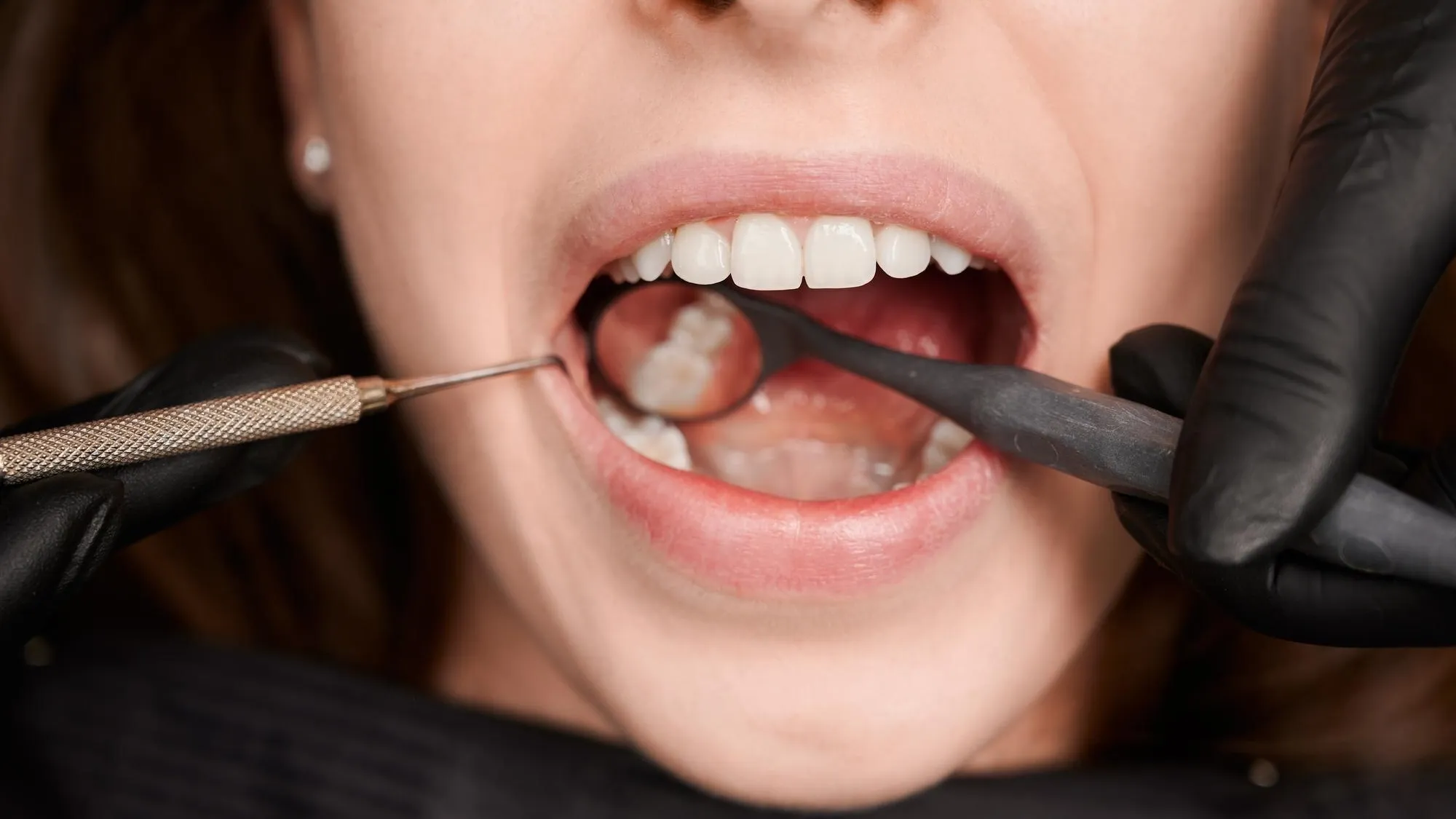

At the beginning, cavities rarely cause pain. The tooth looks whole, although certain changes are already happening in the enamel. You may notice a matte area, a dark spot, roughness, or sensitivity. However, a diagnosis based on color is not made, as plaque, fluorosis, and hypoplasia can appear this way.
A home examination helps to notice a certain problem, but does not show the depth of the damage. It is particularly difficult to assess the surfaces between teeth and the grooves. Therefore, the answer to the question of how to recognize cavities can be divided into two stages: a home examination of the teeth and confirmation of suspicion by a dentist.
What is initial caries and why is it easy to miss
The term “initial caries” refers to early damage to a tooth, where the enamel loses minerals but remains intact. Plaque bacteria metabolize carbohydrates and produce acids. If such attacks occur frequently, demineralization of the enamel begins. That is, it becomes more porous, changing in sheen and transparency.
At this stage, there is no cavity yet, and the nerve inside the tooth is located far from the affected area. Therefore, a person usually does not feel anything. Changes may be located near the gums, between teeth, or in fissures, so self-examination does not rule out hidden damage.
How caries looks in the early stage: white and dark spots
To understand what caries looks like, one should assess not only the color but also the surface of the tooth, its location, and changes over time. An active chalky spot is usually opaque, matte, and more visible after the tooth is dried. It often appears where plaque accumulates, for instance, near the gums, braces, or contact areas.
At the same time, a white spot on a tooth does not always indicate disease. Symmetrical changes from the moment of eruption may manifest as fluorosis or enamel formation disorders. Cavitated areas tend to appear later in areas of plaque retention. A doctor can distinguish these conditions after drying the surface.
A dark spot also does not always signify a cavity, as pigment may get trapped in a natural fissure. Meanwhile, an area with roughness, softening, or defects requires diagnosis.
Step-by-step self-examination at home: mirror, light, floss
A dental check should be performed once a month after brushing. For this, you will need a mirror, light, and floss. The procedure is carried out step by step:
- Wash your hands, brush your teeth with a toothbrush and floss.
- Examine the outer, inner, and chewing surfaces, comparing the teeth on the right and left.
- Look for new matte, white, brown, or black areas, chips, and indentations.
- Run the floss between your teeth without sudden movements. Remember the spots where it constantly tears or gets stuck.
- Check for any localized sensitivity and whether food gets stuck.
Do not use a needle, pin, or any sharp object for this. You may injure the gums or damage weakened surfaces. Flossing also does not provide a diagnosis, as it can get caught on calculus or the edge of a filling.
Where early caries most often "hides"
It is particularly difficult to notice interproximal caries, as the contact surface is covered by the adjacent tooth. Fissure caries, areas near the gums, braces, crowns, and fillings also remain hidden. In such cases, a doctor may prescribe X-rays or other diagnostic methods based on indications.
What sensations may appear before a "hole"
Typical early symptoms of caries may be absent. Sometimes there is a short reaction to sweet, sour, or cold, which quickly subsides after removing the irritant. Localized food trapping, unpleasant taste, floss catching, or the sensation of an uneven edge with the tongue should raise concerns.
However, prolonged or nighttime pain, swelling, and fever indicate deeper tooth damage and require prompt examination.
Stages of caries: from a spot to deep damage
The stages of caries can be conditionally described as follows:
- spot appearance — at this time, minerals are lost, but a visible defect does not yet exist;
- surface caries — the integrity of the enamel is breached, and a small defect forms;
- medium damage — the process spreads to the dentin, sensitivity increases, and food trapping is observed;
- deep damage — the lesion approaches the pulp, increasing the risk of pain and complications.
The boundary between these stages cannot be determined independently, as a small dot conceals changes in the dentin, while a dark spot may be pigmentation. Therefore, the treatment strategy is determined by the depth and activity of the lesion.
What can be done before the visit and what is better to avoid
Before visiting the doctor, clean your teeth thoroughly twice a day with fluoride toothpaste of appropriate concentration. Take care of the gaps using floss and interdental brushes. Take a picture of the changed area and note what provokes sensitivity.
Do not apply acids, baking soda, hydrogen peroxide, concentrated fluoride products, or "fillings" from marketplaces on the tooth. Do not scrape the spot or take antibiotics. If a cavity has already formed, home remineralization will not close it.
When it is essential to see a dentist
A dentist's consultation is needed if you notice a new white or dark area, roughness, indentations, experience food getting stuck, feel floss catching, or have a reaction to sweets and cold. It is important to remember that one should not postpone a visit to the doctor, even when the spot does not hurt. Early changes can often be controlled by gentle methods.
Emergency help is required for severe pain, swelling of the gums or face, accumulation of pus, fever, a tooth injury, difficulty swallowing, or opening the mouth. In the absence of complaints, regular check-ups and professional teeth cleaning at individually determined intervals are important.
How early caries is treated in the clinic: remineralization, fluoridation, ICON
After the examination, cleaning, drying of the teeth, and necessary imaging, the doctor explains what is done for caries in your case. Lesions without cavities can be treated conservatively: hygiene and diet are corrected, remineralization or fluoridation is prescribed, and the area is monitored.
If a cavity has formed, treatment for caries with removal of affected tissues is necessary. Teeth filling is carried out with a material chosen based on the defect, load, and aesthetics. Depending on the depth of the damage, a therapist, orthodontist, and other specialists may be involved in the treatment. The therapist treats root canals in cases of pulp damage, while the orthodontist restores a significantly damaged tooth using an inlay or crown. Specialists at Dobrobut Dental Clinic develop a treatment plan after comprehensive diagnostics to ensure the patient understands the sequence of interventions and the results they will achieve.
 36 views