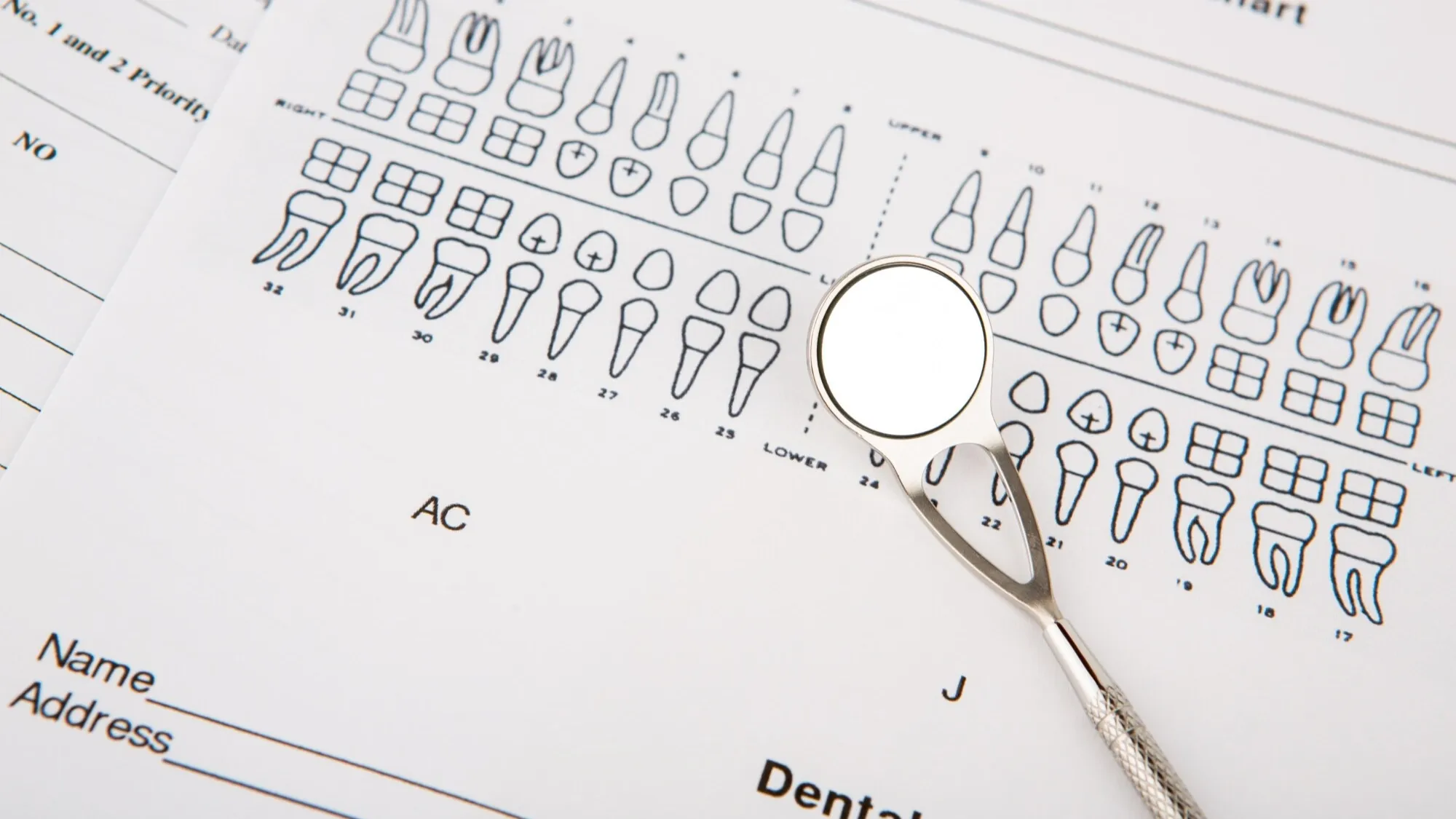

Designations such as 16, 24, or 38 in a medical chart are not ordinal numbers within the entire dental arch. By this number, the doctor identifies which jaw, its side, and which tooth are being referred to. The most common dental numbering system in Ukraine is based on the two-digit FDI system: the first digit indicates the sector of the oral cavity, and the second indicates the position of the tooth from the center of the arch.
This notation helps accurately convey information during examination, treatment, and analysis of images. For example, 16 refers to the first upper right molar, while 38 refers to the lower left wisdom tooth.
Why Dentists Use Numbers Instead of Familiar Names
The phrase “upper right molar” can be ambiguous: several molars are located in that area, and the term “right” can be perceived differently by the doctor and the patient depending on their positions. Tooth numbers eliminate such ambiguity. Code 26 in a card, referral, or treatment plan always denotes one specific tooth.
Thus, numerical designations are necessary to:
- document examination results in the medical record;
- link the diagnosis and planned procedure to a specific tooth;
- describe the location of cavities, fillings, crowns, or inflammation;
- compare clinical data with X-ray images;
- communicate information between dentists of different specialties;
- monitor changes during prolonged treatment.
How Dentists Number Teeth in Ukraine
In dental practice, teeth are primarily numbered using the FDI system, as established by the international standard ISO 3950. In this system, the oral cavity is conventionally divided into four sectors. The numbering is from the patient's perspective, not the person standing in front of them:
- 1 — upper right;
- 2 — upper left;
- 3 — lower left;
- 4 — lower right.
The second digit indicates the tooth's position within the sector. Numbering starts from the midline of the face: the central incisor receives the number 1, the lateral incisor — 2, the canine — 3, the premolars — 4 and 5, and the molars — 6, 7, and 8. Thus, the tooth chart is read sequentially: first, the sector is determined, and then numbering proceeds from the center of the jaw towards the back.
The digits are pronounced separately. The designation 24 is read as “two four,” not “twenty-fourth tooth.” Sometimes, for clarity in records, a dot is placed between the numbers, but 1.3 and 13 in the FDI system mean the same thing.
What Does a Number Like 1.6 or 3.8 Mean?
In the code 1.6, the first digit specifies the upper right sector, and the second indicates the sixth position from the center. This is the upper right first molar. It is usually referred to as “six” since it is positioned sixth within that half of the jaw.
By the same principle, 3.8 is defined as the eighth tooth in the lower left sector, meaning the lower left “eight.” If such a tooth is absent due to non-eruption, congenital absence, or extraction, its code does not shift to the neighboring position. Therefore, each position remains unchanged.
To understand how to count teeth, one can imagine an arch from the middle to its end. Each half of the permanent dentition contains two incisors, a canine, two premolars, and up to three molars. This is why the second digit in the FDI system ranges from 1 to 8.
How Primary Teeth Are Numbered in Children
Pediatric dentistry employs a separate numbering system for primary teeth. This is necessary to avoid confusing a temporary tooth with a permanent one that occupies a similar position. The numbering of primary teeth uses sectors 5–8: 5 — at the top right, 6 — at the top left, 7 — at the bottom left, 8 — at the bottom right.
In each sector, there are five positions: two incisors, a canine, and two molars. There are no premolars in the primary dentition. For example, 51 — upper right central incisor, 64 — upper left first molar, and 85 — lower right second molar.
During a mixed dentition phase, both primary and permanent teeth can be present in the mouth simultaneously, making correct coding especially important. During a visit, the pediatric dentist assesses not only the presence of cavities but also the timing of eruptions, the sequence of tooth changes, the condition of the gums, and the development of the bite.
What Other Numbering Systems Are Used Worldwide
There is no single system that is universally applied in all countries and fields of dentistry. Therefore, identical tooth names in different documents may be accompanied by other symbols or numbers. The most well-known alternatives to FDI are the Zsigmondy-Palmer, Hadrupp, and Universal systems, which is prevalent in the USA.
In the Zsigmondy-Palmer system, the jaw is divided into four quadrants using angular symbols. Permanent teeth are denoted by numbers from 1 to 8, counting from the central incisor, while primary teeth are designated by letters from A to E. This format is convenient for diagrams, but angular signs may not always be correctly displayed in electronic documents.
According to the universal ADA system, permanent teeth are assigned continuous numbers from 1 to 32. The numbering starts with the upper right “eight,” traverses the upper row, and then continues below. Primary teeth are labeled with letters A–T. Therefore, the same tooth in FDI and Universal has different numbers. Thus, it’s essential to clarify the system used in foreign documents.
What Are Teeth Called If Not by Numbers
Anatomical names describe the shape and primary function of teeth. Incisors are located at the front and are intended for biting food. Canines have a pronounced cusp and help tear food. Premolars, or small molars, crush food, while molars, or large molars, perform thorough chewing.
The complete formula for permanent dentition for one half of each jaw is 2–1–2–3: two incisors, one canine, two premolars, and three molars. For primary dentition, it is 2–1–0–2 since children do not have premolars and third molars.
Anatomical names and numerical codes complement each other. For example, in the entry “first molar 46” — these words explain the type of tooth, while the number precisely identifies its location.
How to Read a Tooth Number in a Card or on an Image
Upon seeing a two-digit designation, first determine which system the document is drafted under. If it is FDI, split the code into two digits and identify the sector from the first. Then use the second to find the position from the central incisor. For instance, 12 — upper right lateral incisor, 25 — upper left second premolar, 47 — lower right second molar.
It is important to consider the orientation of the image. A panoramic image is typically shown as if the doctor is looking at the patient from the front: the right side of the person is on the left for the viewer. Because of this, patients sometimes find it challenging to discern from the image which specific tooth is troubling them. Moreover, the designation in the description does not always mean that it is the one that needs treatment. Pain can radiate to a neighboring area. Therefore, dental X-rays are correlated by the doctor with the patient's complaints, examination findings, and results of clinical tests.
At Dobrobut Dental Clinic, numerical designations are used alongside clinical data and diagnostic results. During the dentist consultation, the patient is informed about which tooth is involved, what has been found, and what further actions are recommended. Depending on the situation, other specialists such as a therapist, pediatric dentist, surgeon, orthodontist, periodontist, endodontist, prosthodontist, and others may be included in the treatment planning.
 111 views